Veni(ce) Vidi Vici
JR DRIES ANISH & PEGGY TOO
Bienvenue and welcome back to Musée Musings, your idiosyncratic guide to Paris and art. This week, Ginevra takes over again to tell you about all the palazzi that she visited, that we were supposed to visit together, in Venice during the 2026 Biennale. She leaves Paris in a few days and I am missing her already. The next canicule (heatwave) is scheduled to descend upon Paris the day she leaves. So, I will be missing her from the shuttered confines of my little apartment. On the bright side, it will give me time to write about the exhibitions I saw in London and Paris these past few weeks. There is nothing to say about the 250th anniversary of the signing of the declaration of independence except that Thomas Cole’s Westward the Course of Empire wasn’t only about Rome. Gros bisous, Dr. B
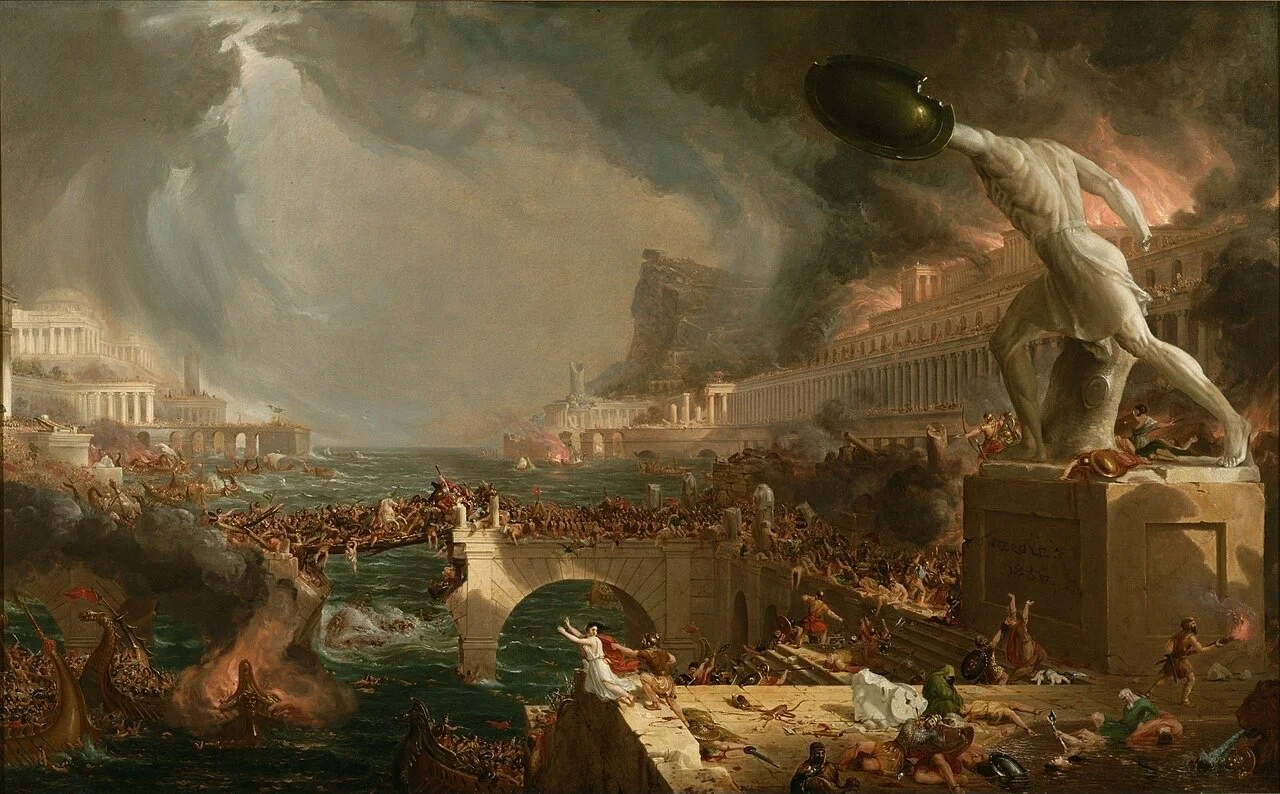
Thomas Cole, Course of Empire, Destruction, 1836
Hi! Ginevra here. This week I am reporting on all the Venetian palazzi that I visited. I’ll start with my favorite although it was actually the last palazzo I saw this trip, but even if it had been the first, it still would have been the best!
JR at Venice Venice Hotel: this was my absolute favorite experience, the total highlight of my trip. Mom booked us tickets to see a work by the artist JR, you will have probably read a number of articles by mom on the work of JR. She likes him so much that her children are basically jealous, but also relieved that she is now obsessed with him and has seemingly moved on from her Lin Manuel Miranda obsession. It can be irksome when your Mom always wants to talk about how great Lin Manuel is, you know?
If you need a refresher on who JR is, this is from the Perrotin Gallery - “JR is a French contemporary artist whose work exists at the intersection of photography, public art, film making, and social engagement. For more than two decades, he has created monumental public interventions around the world, actively involving local communities in the creative process.”
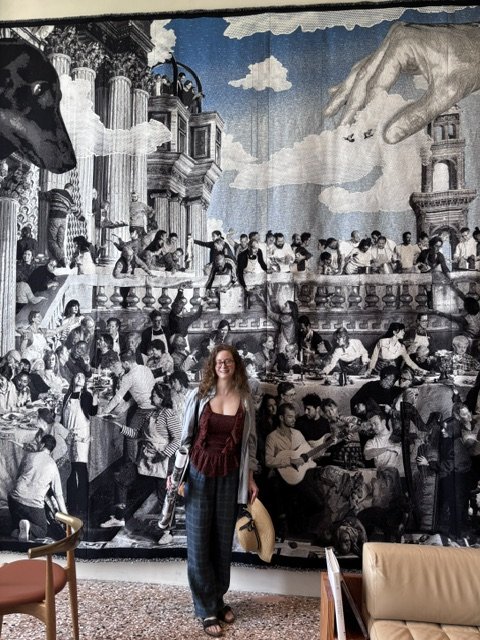
I really had no idea what I was going to be seeing. The day we had it booked, I stayed in the little apartment with Mom and we scrambled to book a hotel room near the train station so that it would be better for her the next day (a Rick Steves recommendation of course, never leave the house without him). After that was secure I was running a bit late for the 11am “event”. I got to the hotel which was only 5 minutes from our Airbnb at about 11:15am, the girl at the desk said it was fine in her somewhat bitchy Italian way, and that I could just stick around and take the 11:30am tour. I waited in a delightful little courtyard. Fifteen minutes later, I got up and about 5 of us were led into the hotel by a handsome young Italian man. He took us to a part of the hotel on the waterside and I looked down and there was Michelangelo’s Pieta, but it wasn’t of course because for one that it’s in Rome and for another the Jesus was missing! Sorry what? Well just what I said, Jesus was missing. I mentioned this to the guide. He then asked if stairs were ok and I answered yes, but then checked with the older lady behind me. Up the stairs we went into a dining room, long and narrow but elegant. On the walls were cutouts of people, photographs in black and white which if you are familiar with JR’s work are a signature of his. The young Italian man, who by the way says Michelangelo in a way that makes you melt, told us that the Venice Venice hotel was one of the oldest buildings in Venice (um aren’t they all?) and that these works on the wall by JR were permanent. His work is now integrated into the decor, the modern fresco I said. If you think about all the frescoes and the history of wall decorations in Venetian palazzi you realize the significance of this, of JR adding to the history of this very old city. We then went into the sitting room for the piece we were there to see, Il Gesto. Il Gesto is a contemporary reinterpretation of the Italian painter Veronese’s Wedding at Cana which was originally created for the monastery of San Giorgio Maggiore on the Grand Canal, and which is now at the Louvre because as the hot Italian guide said, “Napoleon stole everything.” JR’s piece is a photographic collage of 174 members of the Refettorio Paris community - volunteers, guests, chefs. The mural was then woven into a tapestry by Fondazione Bonotto. BTW - “Refettorio Paris, founded by a group of very involved friends including JR, is a fine-dining restaurant where surplus food is transformed each evening into three-course meals served to people in need.”
The wedding at Cana represents the miracle of Jesus transforming water into wine, JR’s tapestry depicts the miracle of volunteers creating food for those in need. It was really special to see this art in situ, the tapestry, the photos on the wall showing the process, the frescoes in the dining room and the celebration of a community organization feeding the disenfranchised.” “What idea of community are we building today? Who is truly visible? Who is invited to sit at the table?” — JR
Back downstairs I finally found Jesus! Not in the way you think, but as in the part of the Pieta that I hadn’t seen before that revealed itself to me, which was very exciting. I asked the guide who the artist was but I forget and google sucks so maybe I have to ask ChatGPT but not right now because I’m not trying to validate a bunch of tech bros in San Francisco, thank you.
The guide then told me that this part of the hotel was modeled after a design by the architect Carlo Scarpa. It was at this point my jaw dropped completely and I asked if he would like to get married. I’m looking for a man who says Michelangelo, Veronese, and Carlo Scarpa in casual conversation. Anyways I was very excited, Carlo Scarpa is one of my favorite architects, a native Venetian, he designed only one building in this crazy place, but I visited it and loved it and of course you may recall how much I love his courtyard at the giardini. So that was it. A wonderful visit, a great JR experience, I’m in love and I found Jesus.
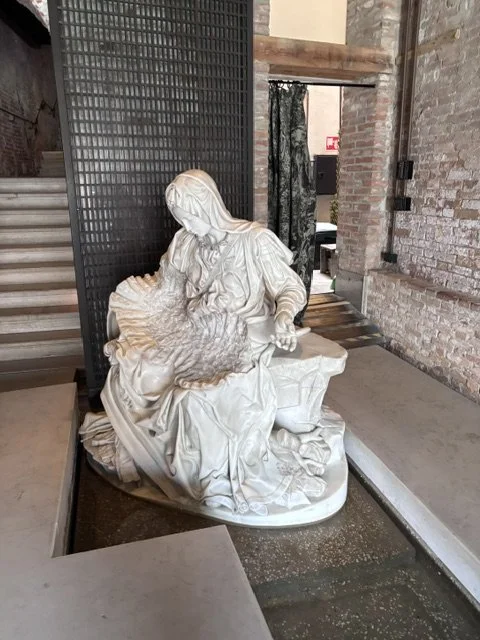
Hey Mary! where is Jesus?!!
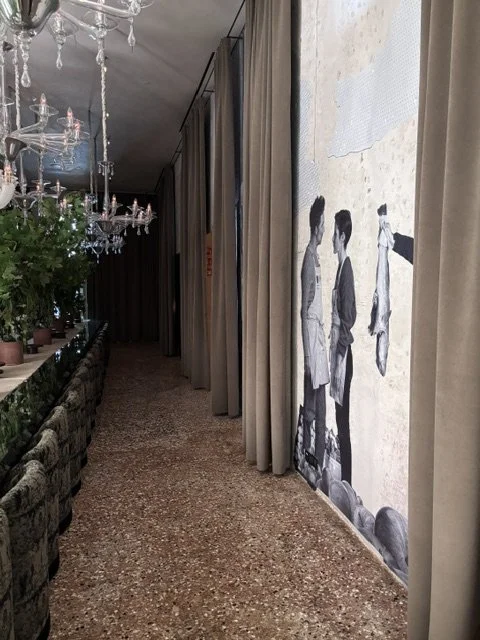
JR artwork on the walls of the dining room.
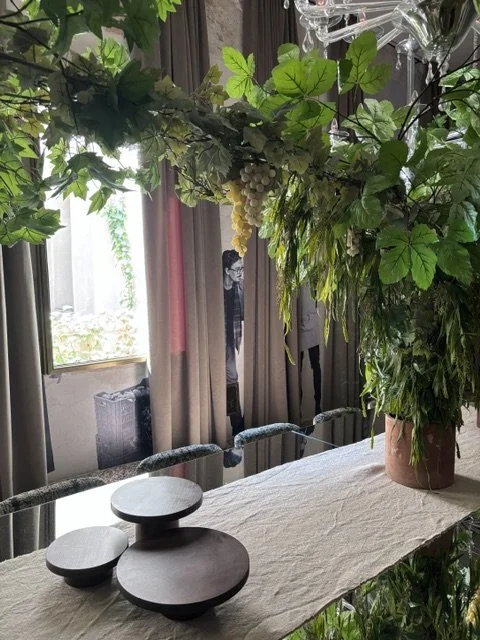
One of the figures peeping through the curtains!!
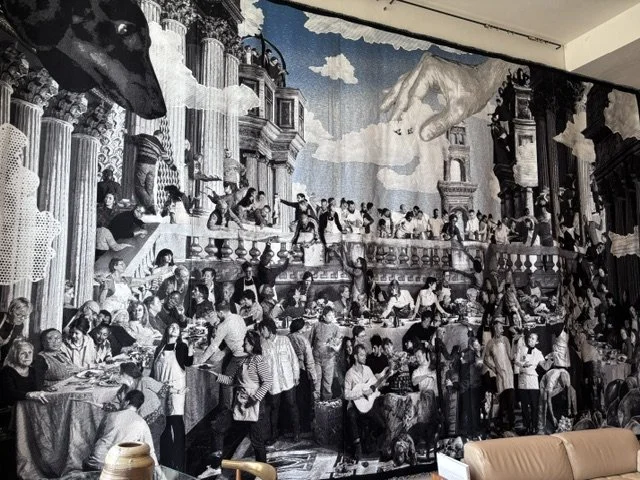
“Il Gesto” by JR made into a tapestry by Fondazione Bonotto
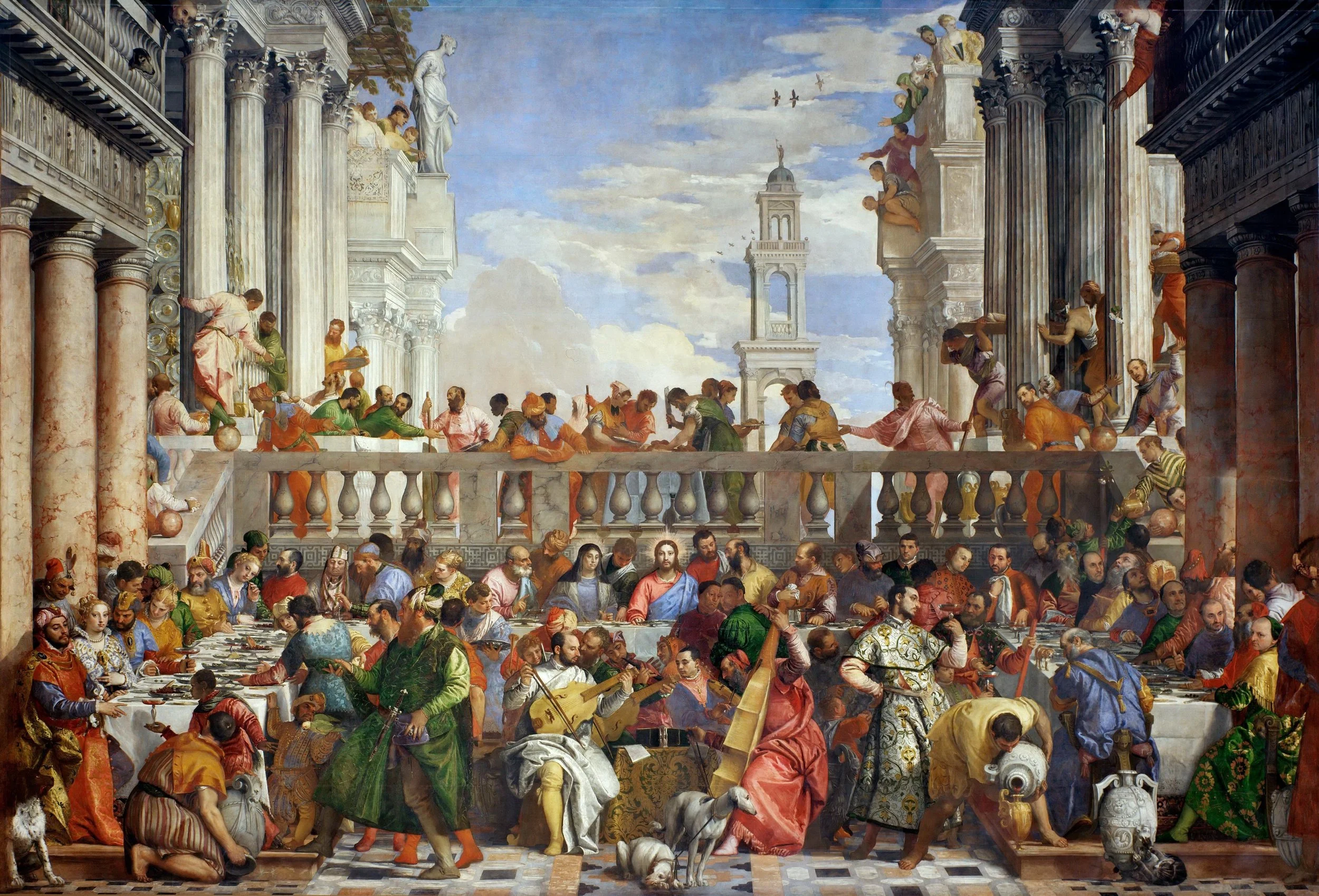
The Wedding at Cana by Paolo Veronese.
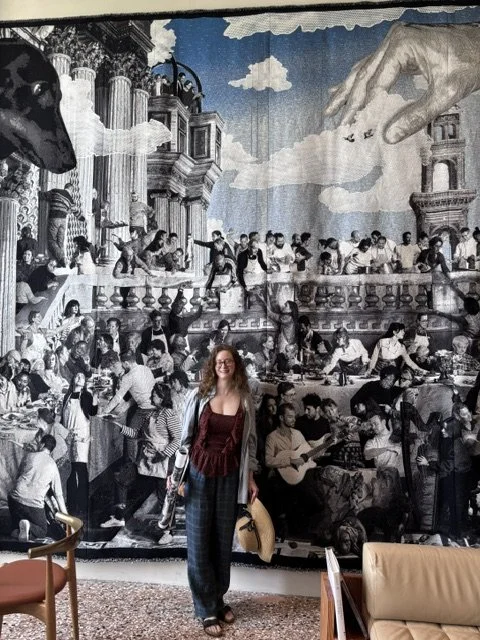
Happy to be here!!
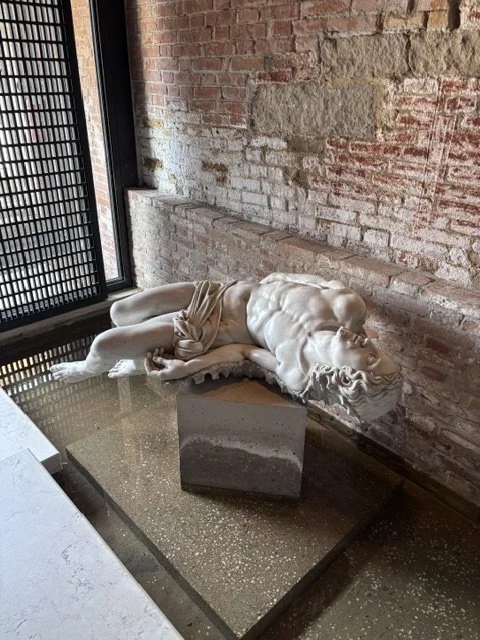
I found Jesus!!
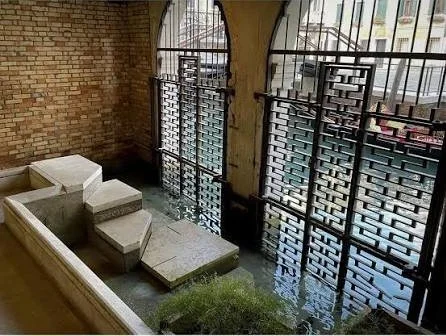
the fondazione querini stampalia renovated by Carlo Scarpa and the inspiration for this canal side room at the hotel Venice Venice
Fondazione Dries Van Noten: When I read in Vogue that the fashion designer Dries van Noten had recently purchased a palazzo in Venice and would be holding his first exhibition there this summer, I was very excited. When I looked on the website, I loved the name of the exhibition “The Only True Protest is Beauty” and I loved the photos - detail shots of art, craft, fashion, all beautifully lit and very airy. As well as a gorgeous day-lit photo of one gorgeous interior space. Alas, the reality was different. The space was very dimly lit. Did I say very? I mean very very very dimly lit. When you’ve just been outside in the blazing sun-drenched smorgasbord that is Venice and you go inside and its dark, well quite frankly you get a headache and it’s hard to see. I understand conservation but this was conservation plus affectation. This was the first palazzo we went to when Mom was still holding it together and this pushed the migraine right to the front of her head, and it didn’t help my head much either. I enjoyed the exhibition, there was so much in there, but at the same time it was hard to enjoy because of the dim lighting and I am sure that not all the works needed to be lit like that.
Some excerpts from the description: “Curated by Dries Van Noten with Geert Bruloot, the presentation considers craftsmanship as a language of expression and a conduit for emotion. Works from fashion, jewelry, design, art, photography, glass, ceramics, and material experimentation move beyond the boundaries of traditional disciplines.” It was great to see all of these works from so many disciplines in dialogue with each other. Mom and I recognized some of the artists and were happy to be introduced to new ones. But again the method of learning - videos on the artists - tiny and in the dark, was challenging. As I moved through the spaces, I encountered wonderful surprises - both in the art and the palazzo itself. (Mom had to stop looking almost immediately, she waited for me in a reasonably lit space) I was surprised that Dries did not include any of his own designs and just as surprised that there were only two designers chosen to represent fashion - Christian Lacroix and Comme des Garçons - two amazing but also very well known designers, examples of whose works were in almost every room. There was a single new fashion designer, a young Pakistani designer who was using traditional dress in new ways. His work was fantastic and inventive.
I was very happy to see this mix of art and craft and fashion by a range of artists (if not designers). The exhibition was expertly curated, however, I’m still not convinced that dark was the way to go. And actually, the more I think about it, the more annoyed I am becoming. I’ve got my architect father whispering to me in one ear saying to make sure its south facing and David Hockney in the other ear, going bright light is what drew me to LA. And I’m just wondering why all this beautiful art had to be presented in the dark (and make Mom sick)?
Here’s one example of the kind of art that filled the space. On huge panels, an artist/photographer had photos of sleeping people that he had found online. He took the photos, cropped them, enhanced them and then enlarged them. The first sleeper was a young woman with her head flung back and a scarf around her hair. I knew who she reminded me of right away - Bernini’s statue of Santa Theresa. When I said that to one of the guides, she told me that Santa Theresa was the name of the photo.
The entire installation was a work of art. How the visitor was supposed to move through the space was fully curated. I felt as if I was on a leash held by Mr van Noten. A designer leash to be sure, but a leash nonetheless. I couldn’t help but wonder if maybe I could have walked a different path and had another, equally as satisfying experience. Maybe they believed that darkness is more immersive but there is a reason my dad always checked the natural light and never let us use overhead lighting.
One more thing. There were a number of young people standing around the entries to each room (maybe they didn’t like being in the dark anymore than we did). It wasn’t clear if they were guards or if they were guides. It wasn’t until we went into a room in which an older woman was standing. Maybe because time goes more quickly when you are actually doing something rather than standing around, but for whatever reason, she shared a lot of information with us that we were delighted to have. It certainly enhanced our appreciation for the piece. I tried to engage with some of the younger guides but they were not as affable, or maybe not as knowledgeable.
Overall it was very interesting, but open the fricken curtains next time, please Dries.
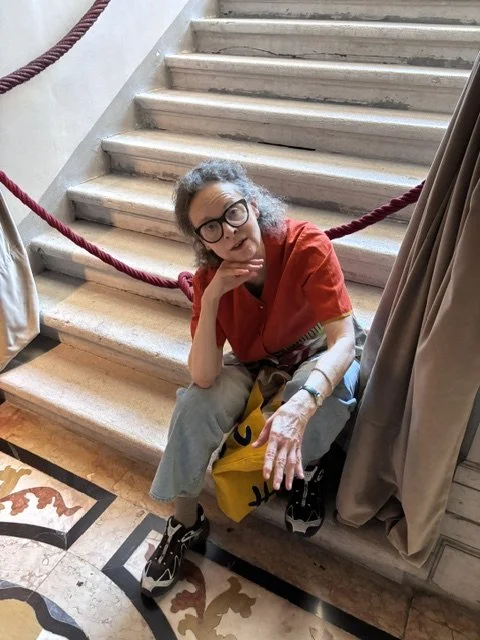
Mom in the one well lit area of Fondazione Dries van Notten (ironically blocked off) trying not to get sick(er)…
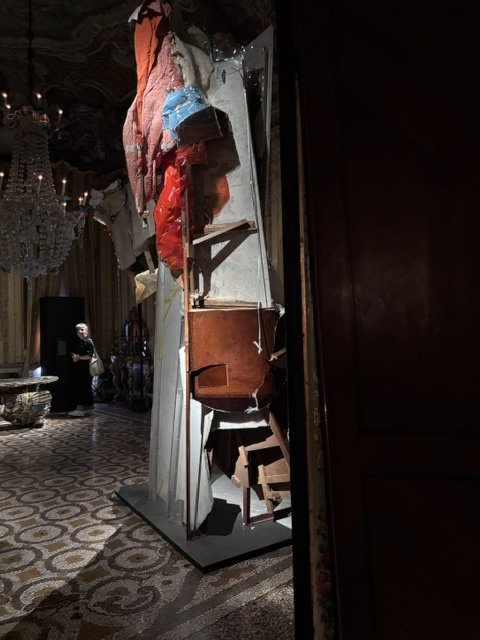
We’re in the dark here!!!!
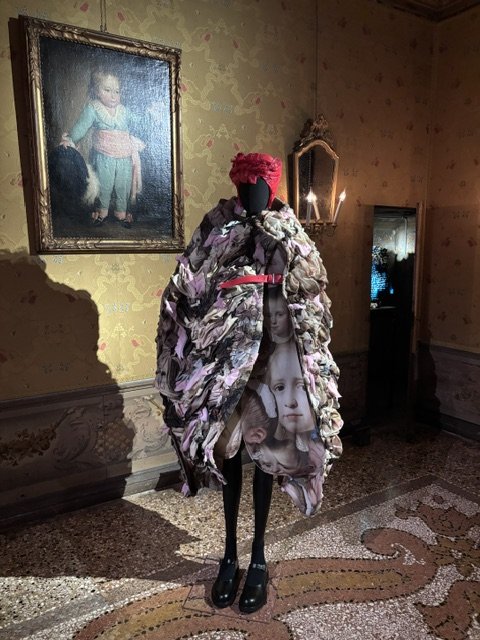
Commes des Garcons paired with a painting found at the Palazzo, very fun. But notice the shadow cast because of the dark interior and the artificial lighting.
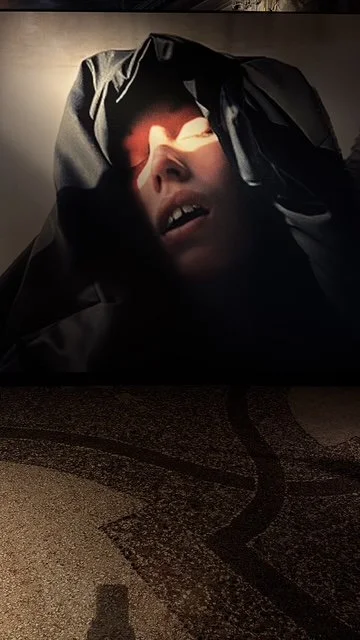
Santa Theresa - enlarged photographic artwork.
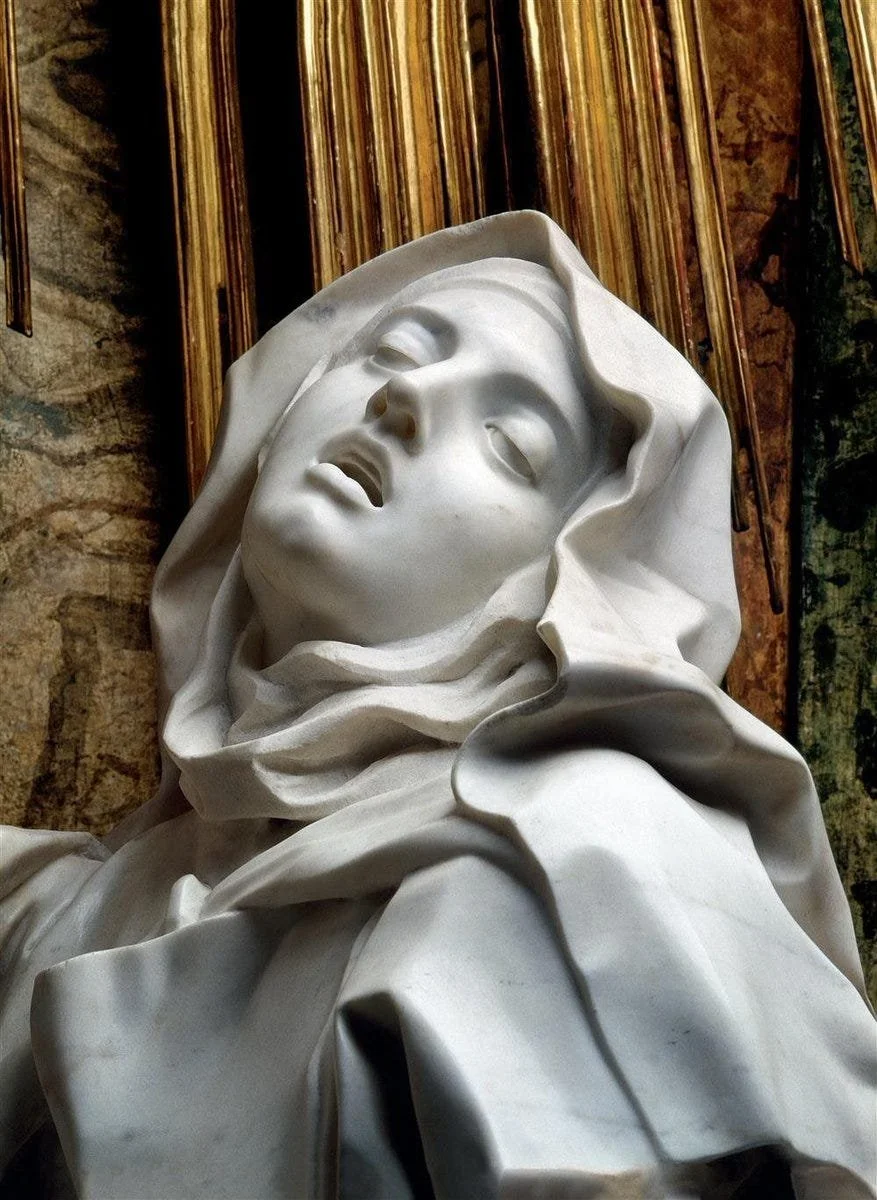
Detail from Bernini’s sculpture Santa Theresa in Ecstasy.
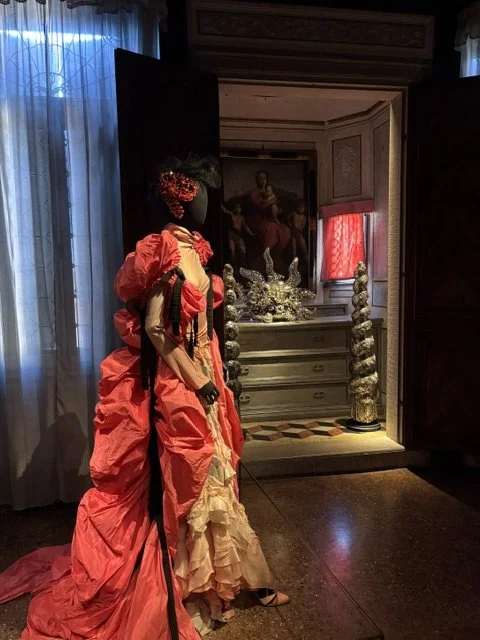
Christian Lacroix gown paired with works by a female artist who uses cutlery to create sculptures - these were placed in the Palazzo’s mini chapel, a feature of many Venetian Palazzi the mini chapels are cantilevered over the canal so that God can find you as you pray.
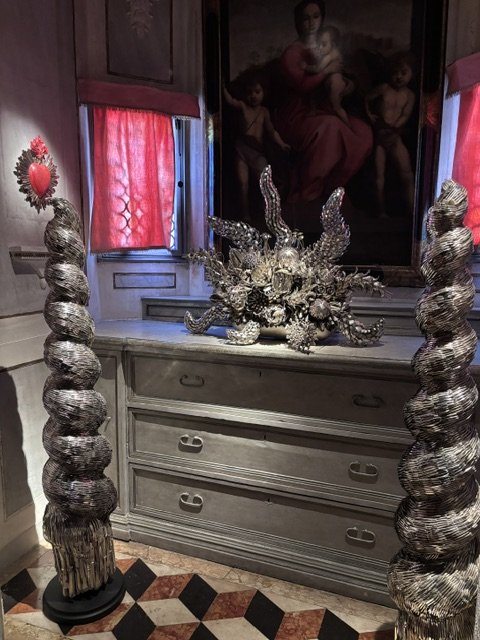
These sculptures are made out of forks and knives.
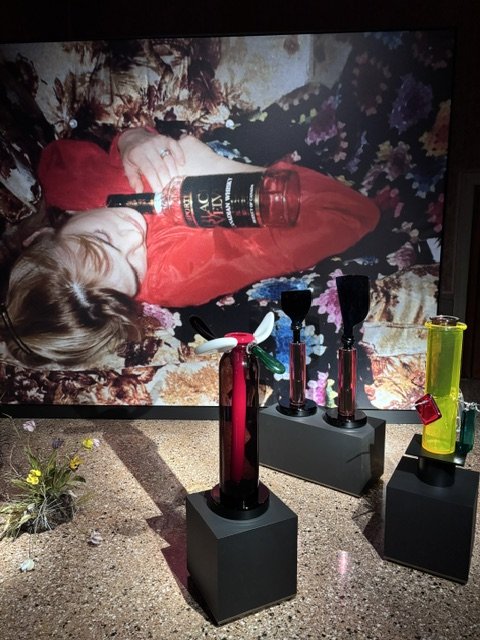
Glass art works and another enlarged photography piece.
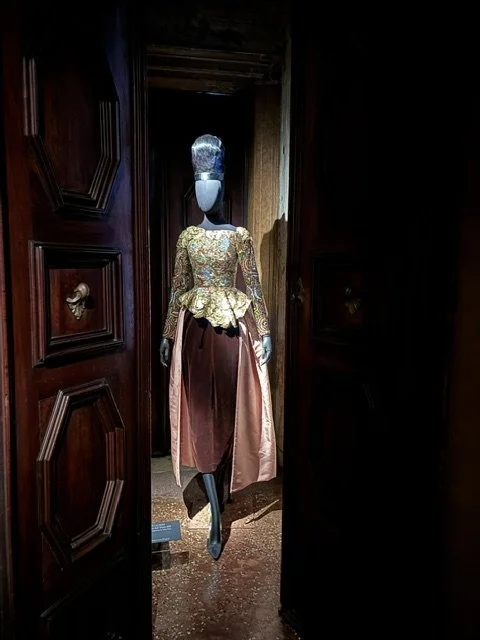
Peek a boo!
Peggy Guggenheim Collection: this is a lovely little museum. I came for the special exhibition, on Peggy in London. It was great to learn about how Peggy’s pioneering taste developed especially early on when she had a gallery in London. The exhibition is presented in a series of small rooms so you are not overwhelmed. Happily it is also very well lit! Nothing dark and mysterious here. And it was great to see the artwork of artists at the beginning of their careers.
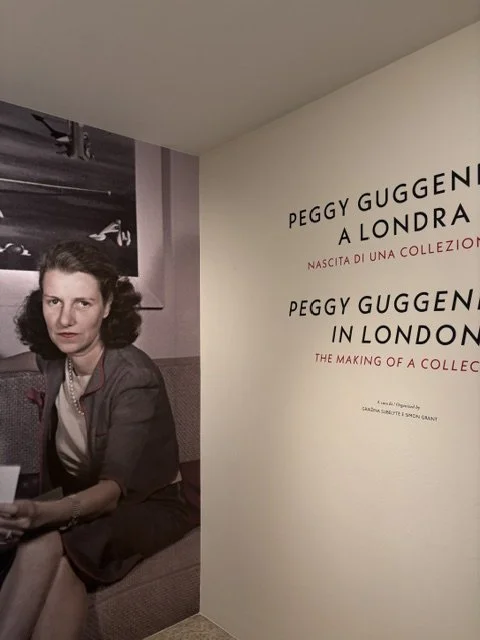
Cute Peggy with seriously good taste.
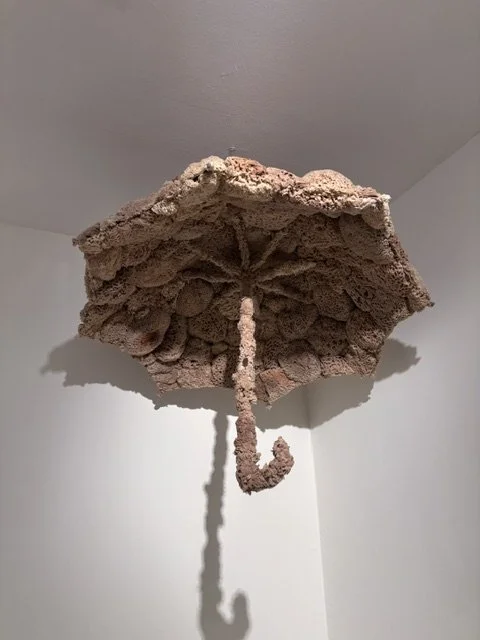
I loved this - an umbrella made from sponges!! The artist is Wolfgang Paalen
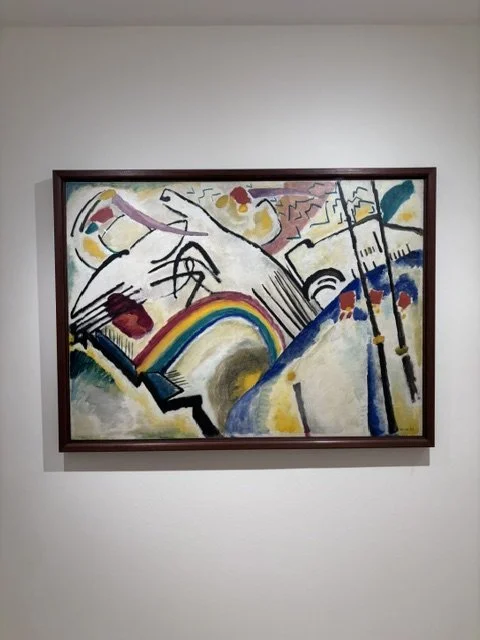
A nice Kandinsky.
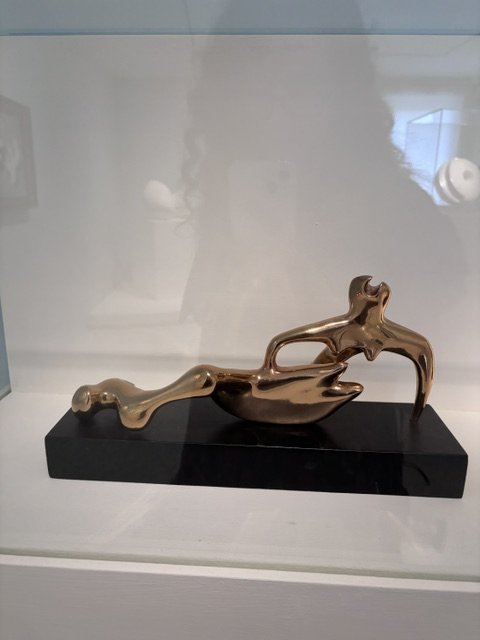
Henry Moore piece.
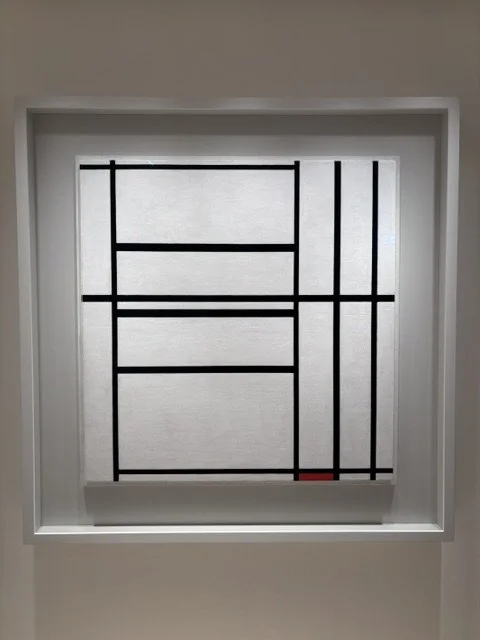
My man Mondrian.
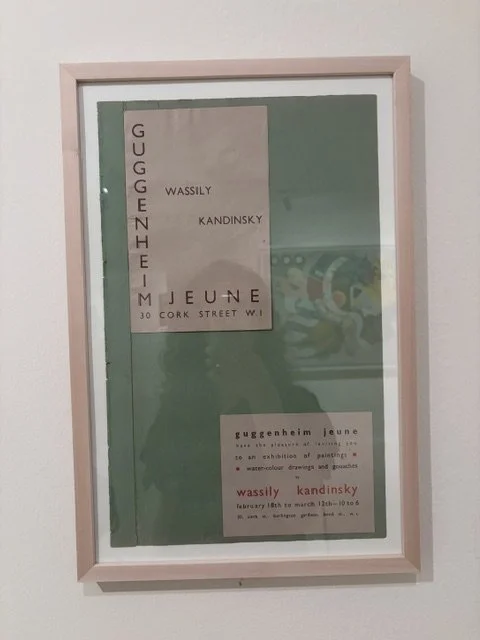
A flyer for the Guggenheim Jeune in London.
Palazzo Manfrin - First of all, I wasn’t sure when I wanted to go so I didn’t want to buy a ticket online in advance. And besides that, I didn’t like that they tried to add on the price of the exhibition catalogue while I was buying a ticket. How would I know if I wanted to buy a catalogue before I saw the exhibition. Anyhow, I decided to just show up and buy my ticket at the door. But you can’t buy a ticket at the door because there is no cash register. Which is why you can’t buy a catalogue either, there’s no cash register. So I had to stand in the sun and use my phone and fill out a really long and invasive and obnoxious form, just to buy a ticket to see an exhibition. Um, why does Anish Kapoor (whose palazzo it is that we are talking about here) need to know my birthdate and birthplace? He does not. So I told him I was Swedish and enjoy being an Aries (my birthday is in October). On the other hand, I did enjoy the fact that Kapoor has done nothing to the palazzo so it feels like an artist’s studio, which is fun. The exhibition consists of a number of large mirror works by Kapoor, the kind of works that have become his signature. There were also lots of architectural models of proposed and (fewer) completed installations: “‘Anish Kapoor: Palazzo Manfrin’ will bring together around 100 architectural models documenting projects both realized and unrealized from the past 50 years of Kapoor’s practice, alongside a series of large-scale sculptures and mirror works… Palazzo Manfrin presents Kapoor’s idiosyncratic approach to the space of the object and its potential to create new space in our encounter with it.”
Here’s Kapoor’s explanation, “For a long time I'd been thinking of my work as potential architecture. I've always been convinced by the idea that to create new art you have to create new space.”
When you get bored of what is essentially Anish Kapoor claiming with these models that if anyone had any sense these art/architectural pieces would all have been built, you can look up at the ceiling! And see some beautiful putti (angels) dancing around in a gorgeous old fresco that has nothing to do with this arrogant male artist. Oops, did I say that? It does kind of annoy me that this guy is so full of himself that the exhibition consists of what feels like him emptying out his studio. I love architectural models, I loved making them, but if I had presented my work like this at Berkeley I’d have been in a lot of trouble. Also, where are the in between moments of his thoughts before he even got to the models? Sketches, diagrams, loose mock-ups, the process is fun to see. Not to mention it is extremely arrogant to say that his art is potential Architecture. I love sculpture, I adore art in the public space, but Architecture has a functional component that art does not and should not. Richard Serra knew this and in fact had this very discussion with Frank Gehry, he was not so arrogant as to say his sculptures could be architecture. Also couldn’t Anish Kapoor maybe show the work of another artist - perhaps his work in dialogue with a younger artist? One room, which had a lot of great frescoes on the walls that he hadn’t touched, he essentially covered up with one of his own enormous dome pieces that to me was a combination of a Viking helmet and an old fashion beauty salon hair dryer.
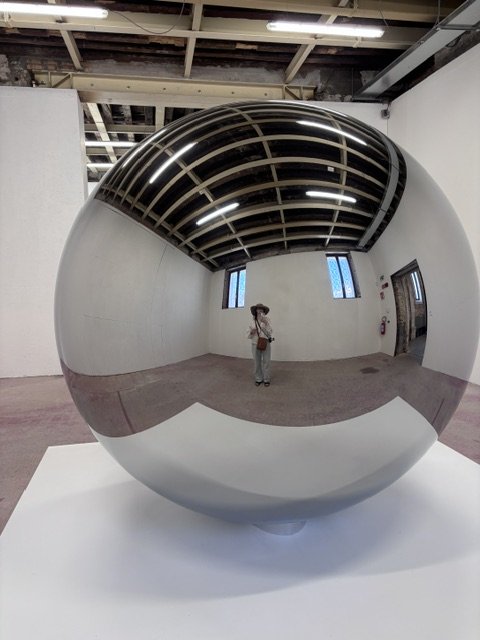
Mirror work by Anish Kapoor - can you see me?
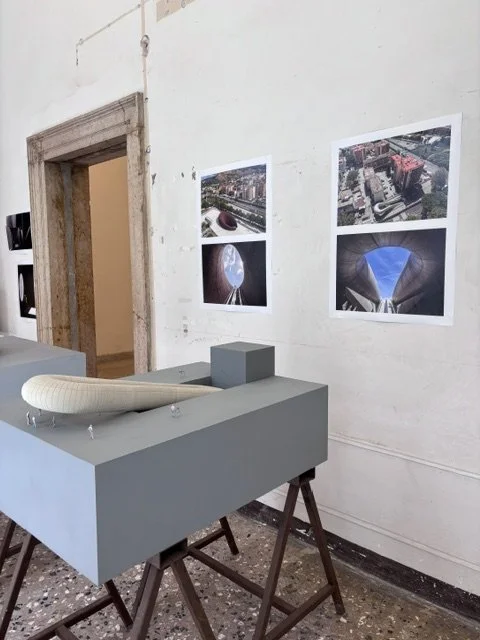
Model and renderings (on wall).
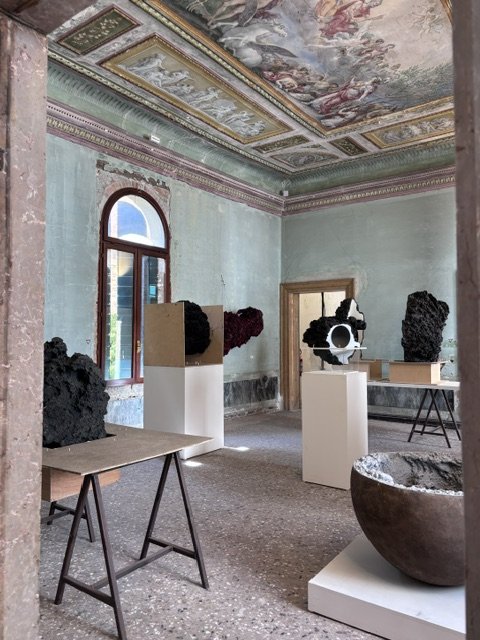
See the ceilings?
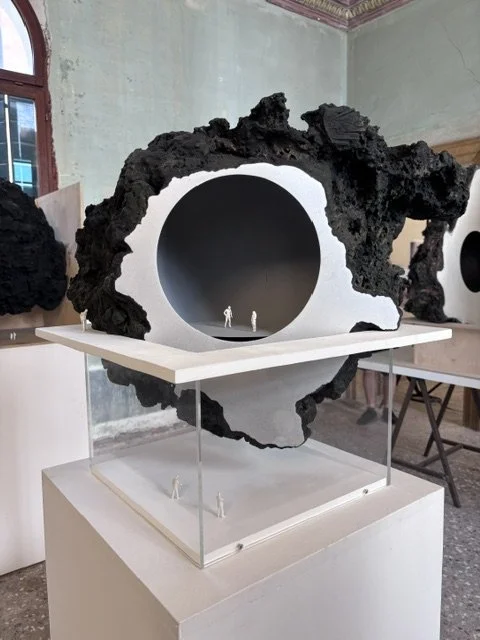
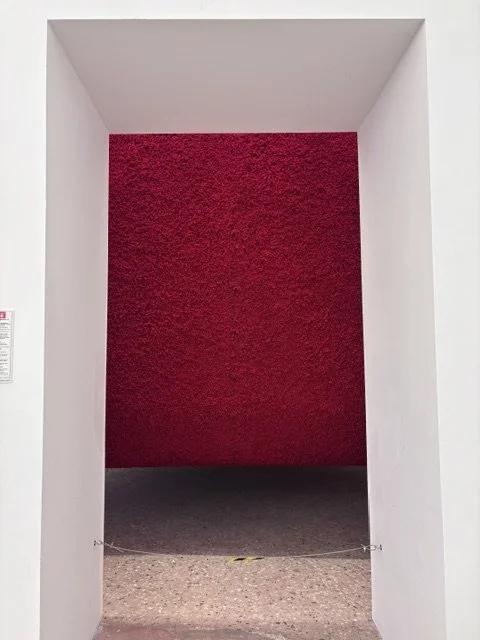
Red pigment in a room which you are not allowed into…didn’t he say his work is like Architecture? but you can’t experience this? Seriously?
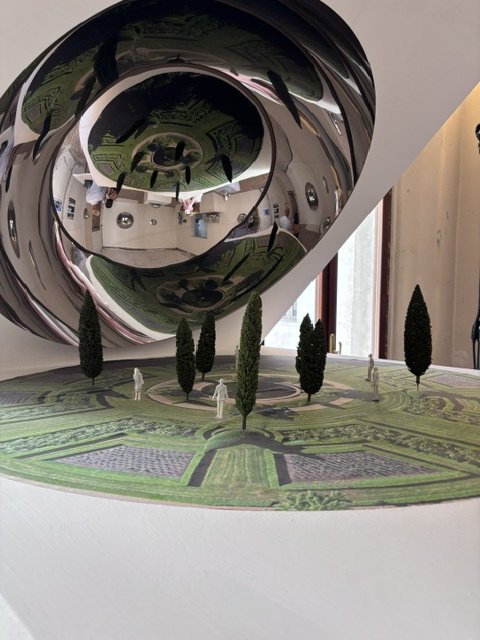
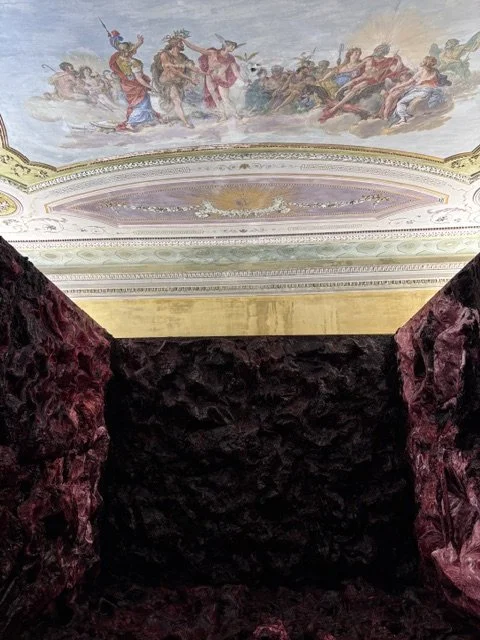
This was one of those works the seems like blood or primal or I don’t know, but you don’t experience it as a space, you walk by it. Nice ceiling courtesy of Venetian artists.
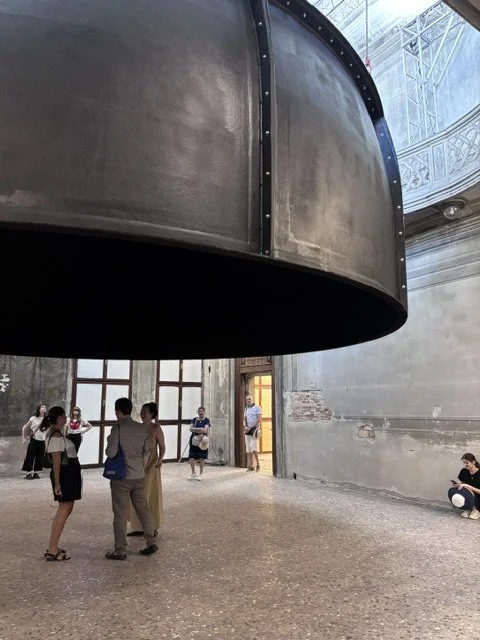
The hair dryer.
And last and (maybe least) Punta della Dogana and Palazzo Grassi - these two contemporary art museums are both owned by French billionaire François Pinault who also owns the Bourse in Paris. For both the Bourse in Paris and the Punta della Dogana in Venice, the Japanese architect Tadao Ando was commissioned to renovate and create anew an historic space, which he did both times beautifully, so for both, part of the reason I go is the architecture. Nobody pours concrete like Tadao Ando. His is like butter. The last time I was in Venice which was 2022 I walked into the Punta della Dogana and found Bruce Nauman, and I was in love with his work immediately. At the Grassi that time was an Italian artist Mom loved, but I was less impressed. This year I went in to admire the architecture again. At the Dogana, I saw the work of an African American artist on the ground floor and an Afro-Brazillian artist on the top floor. In the Palazzo Grassi was an African artist whose work used motifs of western mythology and art history to create large scale paintings that highlight contemporary injustices in his home country of Kenya.
So that’s a wrap! It would have been really nice if Mom had been well enough to experience these Palazzi with me. It would have enhanced my experience, plus I wouldn’t have had to write the article.